Take Back the Narrative, Uncategorized
A narrative on identity and art by artist, filmmaker, and professor K Pontuti
I grew up in a small farm town in Ohio at a time where there wasn’t any language around queerness or transness—at least nothing positive. It was also a time without the internet so information wasn’t as easily available. I remember hearing phrases like “he’s really sensitive,” ”…so creative,” “…so sweet,” “…really insecure,” which later gave way to “he’s a momma’s boy,” “needs toughening up,” “has to learn what is to be a man,” “must be a queer.”
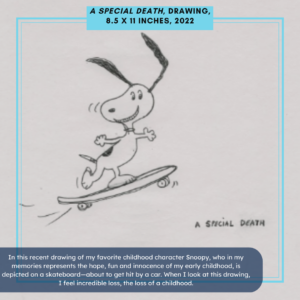
I was quite sensitive, and I could feel my difference although I didn’t quite understand it. I was also creative and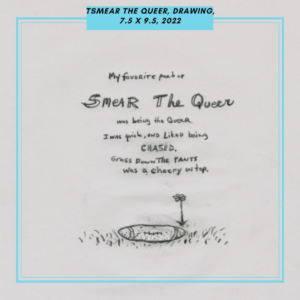 became immersed in my imagination through making things. I taught myself to draw by copying my favorite comics – Charlie Brown and Snoopy were top billed in my cast of characters – and some of my fondest childhood memories are of sewing and crafting with my mom. Soon, though, I was steered towards building model cars and airplanes…“boy stuff.” (My sisters’) Barbies were replaced with G.I. Joes.
Like I think many do, I managed by burying it all, and through determination, desperation, and the privileges of a “straight cisgendered man,” I was able to carve out a “good life” for myself as an adult. At least for a while.
Over the years and in hindsight, I remember sensing glimpses of my yet-to-be-recognized queerness through tinglings and fuzzy feelings but mostly just moments of seeing other people living and experiencing life outside of the cisgendered binary and thinking, “Huh…” and sometimes, “That’s beautiful.”
But life’s responsibilities and gendered pathways and norms didn’t leave a lot of room for me to pose these bigger questions to myself. Even though there was an unrecognizable emptiness, anxiety, depression, and
 dysphoria manifesting as eating disorders, self-medication, over exercising, and an insatiable drive to prove that I was worth something, I must have known subconsciously that someday this this slimy, hairy, shitball-of-a-person inside of me would be exposed—and I’d have to come to terms with it all.
A few years ago, as I was wrapping up post production on our film, The Yellow Wallpaper (not ever imagining that I may have been the tragic story’s trapped woman), I fell into a mental health crisis that landed me in the emergency room. I was fortunate to have checked myself in, and even more fortunate to have a supportive partner and family to get me there and back. I started therapy and a long process of excavating the why’s, how’s, and now what’s of why I had forever felt this way (and, of course, this was all happening through the start of the pandemic).
I also started drawing again which was the other thing that saved me. Immersed in the simple act of putting pencil to paper, the ideas started flowing, the dexterity came back, and then it just exploded and everything poured out.
Since then, I’ve been going all in exploring my identity, trauma, and past. Making new drawings and scouring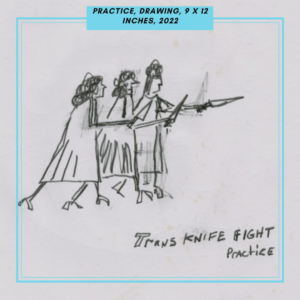 through old ones. Doing more therapy…and lots of shopping.
As might be expected, my artwork explores themes of gender identity, bodily autonomy, mental health, queerness, and trans rights, all from a very personal perspective. The work is very autobiographical and chronicles my transition as it unfolds, in real time.
This past September, I had my first gallery show in ages and titled it Pray And Be Thankful 4 Everything. For me it was a title that walked a line between irony and authenticity. I was so very thankful for everything, but I was also sick and tired of being told that I should be. The exhibition was amazing on so many levels; personally, professionally, and in an incredibly affirming way. I did as many presentations as I could, especially once I saw the impact it was making.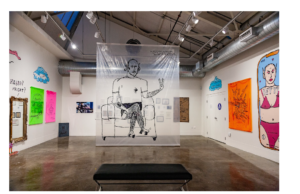
The show provided a platform to start direct conversations about important topics, but definitely raised a lot of eyebrows at the university. Through it all, I’ve received many notes, read student and faculty-written reflections, and had conversations that have brought me to tears. I’ve also felt the ostracization and distancing that many queer and trans people experience. But the good absolutely outweighs the bad, and the joy and satisfaction of realizing who I am, and why I am, has made it one of the most amazing years I could ever imagine.
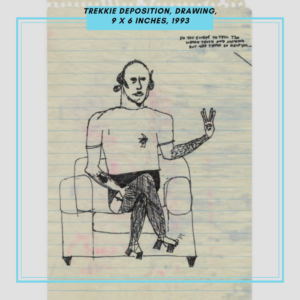
When I look back at my younger self, that sweet kid that liked to sew with mom, who had no idea what was coming their way, no language or support for what was happening to them…I get really sad and feel an incredible loss. The loss of a childhood. And to think it was all spun so well that I thought something was terribly wrong with me.
Now, that sadness turns to anger as I watch people, corporations, even my home state of Ohio, wage war on trans rights (as well as the rights of many others). That sadness turns to rage as I watch the stripping away of the tools, education, and medical care that kids and their families need in order to comprehend who they are and survive.
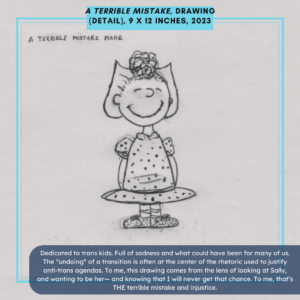
I’m sure it’s not easy to be a trans kid today, but I never had the chance to find out for myself, and the alternative wasn’t so easy for me, either. I’m still doing my daily drawing practice, and I funnel all of my sadness and anger and rage and grief into my art where I can turn it into strength, hope, and self-affirmation. Deep down, I know
these are the things that I need, and I’m now receiving, so that I can continue my journey, and hopefully help others continue theirs.
So yeah, in that sense I am truly thankful.
See more of K’s work on their website: https://www.kpontuti.com/
Uncategorized
It’s not new ground, but it’s worth repeating as a disclaimer: showing up looks different for everyone. Not all of us can afford to donate significant portions of our money or time, and there are many other worthy causes and communities out there in need of attention as well. Terms like ‘slacktivism’ are utterly unproductive. There is absolutely value in posting on social media about Trans* issues; it keeps these issues in the public conscience and shows Trans* people that they have allies out there. On the other hand, there is absolutely no value in criticizing people for showing support to the Trans* community. Of course, people can be doing more than posting on social media, but policing the activism of others is a waste of time, creates division, and only weakens the cause. Stay in your own lane, and focus on the positive!
The very basics of allyship don’t actually take any extra time or effort. I would hope that most of us try to be supportive of the people in our lives. Sort of like a happy birthday message, if you see someone post for International Transgender Day of Visibility, you might send a positive message their way to mark the occasion. I would hope that most of us do some research into the political candidate we are considering voting for. Even when busy, we can hopefully find a few moments to Google the candidate’s stance on certain policies and issues or read their flyer. I would hope that most of us call people out on their bigotry when we judge ourselves able to do so safely, in the same way we would call people out who are just being mean without the bigotry angle. An asshole is an asshole.
Going beyond the basics, I would urge you to join the conversation. A lot has been said about the importance of listening to and not speaking over Trans* voices, but it is equally important not to take this as an instruction to withdraw from the conversation altogether. In a reversal of the idea of ‘slacktivism’, where people’s real motivations and commitment to a cause are doubted and penalized, many people seem afraid that their good intentions will be disregarded in the face of their perhaps poorly-chosen words. One of the most important things an activist or ally to any cause can do is lose their fear of discomfort. Learning comes from a space of discomfort – and this can apply to anyone in any situation. Without putting ourselves in unfamiliar spaces where we may make mistakes, we cannot learn and grow. Put simply: stick around after the talk for the Q&A, and don’t be afraid to put your hand up.
If you’re looking for somewhere to start, we’ve compiled some FAQs about the Trans* community here.
If you’re looking for ways to get more involved – why not take action with us?
Uncategorized
It’s not news in the Trans* community how powerful a tool storytelling can be. Just look at the classic instance of it being used against us in the fear-mongering, fictional tale of a man infiltrating the ladies’ restroom as a “Trans* woman” to then take advantage of vulnerable parties. The recorded instance of anything like this actually happening is non-existent. But that little fictional tale has scared hundreds of people, turned them against the Trans* community, may even have helped make a TERF out of a certain famous author. Apparently, you don’t need facts if you have a good story (as sales of said author’s fantasy books can certainly testify to), and a good story can’t be silenced by facts.
So rather than fight fire with a Health & Safety code (rare is the individual who actually reads those), we must fight fire with water. Why give oxygen to the inflammatory stories intended to demonize Trans* people when there exists a plethora of stories to tell that are a perfect antidote? Endless tales of Trans* folk who have been so impactful as to infringe on the mainstream. Trans* success stories like that of Laverne Cox, Elliot Page, Jonathan Van Ness, Judith Butler, Lana and Lilly Wachowski are as well-worn books, thumbed through by many a reader. Just as important are the local stories. The openly gay and married professor at my university who helped my lesbian friend believe she could live a long and happy life as herself. The Trans* guy I hung out with years ago who is now documenting his transition on social media – the Trans* guy who helped me feel less abnormal. Telling your story gives something for other Trans* folk to identify with and gives people outside the community a real person to sympathize with instead of a twisted stereotype to mock or a skewed caricature to fear. And building these connections builds influence and power.
The #MeToo movement is a useful recent example of the power of storytelling. Millions of people worldwide shared their stories, helping to build a global sense of community and getting most of the planet talking about the pervasive issue of sexual assault. This movement led to charges being brought against serial sexual predators, job losses for many accused figures, and in several states even a ban on the use of nondisclosure agreements relating to incidences of sexual misconduct. Over four years since the movement went viral on social media, more than half of Americans say they are more likely to speak out about sexual misconduct. The number of employed who received training on workplace harassment has increased. The percentage of employed who perceive a serious sexual misconduct issue at their place of work has almost halved since 2017. All because people were brave enough to tell their stories.
Storytelling is important not just to build political power in the current moment, but for crafting a lasting Trans* history and a data resource on Trans* identities and lives. As of right now, alongside the Trans* historical figures we have, there are plenty of famous figures of unknown or ambiguous gender identity, and those presumed to be cisgender. The more Trans* stories we tell now, the more solidified the place of Trans* people in history becomes. The larger the data pool, the harder it is to ignore, the more it has to be factored into more general cultural and political conversations. Trans* literature is an emerging discipline; just as writing by women had to be told again and again to become the established academic sect it is today, writing and engaging with more Trans* stories will help to establish the Trans* voice in literary study. Beyond literature, our language itself is shaped by cultural forces – and the influence of Trans* storytelling has led to words including ‘cisgender’ and ‘genderqueer’ being added to dictionaries. In 2018, the Oxford English Dictionary added ‘Trans*’. Pop-culture is currently littered with slang from and references to queer culture. History is not always written by the victors, but being able to write yourself into history is a form of victory.
Uncategorized
Today, the Supreme Court has ruled that Roe V. Wade be overturned.
This is disturbing, but not surprising. Attacks against abortion have been a common theme in the playbook of colonizers and white supremacists. Today’s ruling is just the latest of their work, setting the stage for further attacks against our own bodily autonomy, and encouraging the belief that others can make choices for your body.
This overturn is a direct attack against the rights we have to make decisions about our own bodies, and we can not let this stand. We must not allow the ignorance and entitlements of white supremacy to go unchecked and we should demand better from all those around us. The time for complacency is over! We need to take action now!
Join us at Trans Empowerment Project as we work to create an equitable future where we all thrive!
If you would like to take action and aid us in amplifying the voices of our communities, come visit our Reproductive Justice Fund Page.

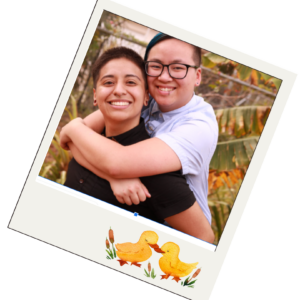 In the burgeoning digital age, it is not uncommon for couples to meet online, and this is
 El and Elliott got married on February 20, 2022, and it was absolutely magnificent and