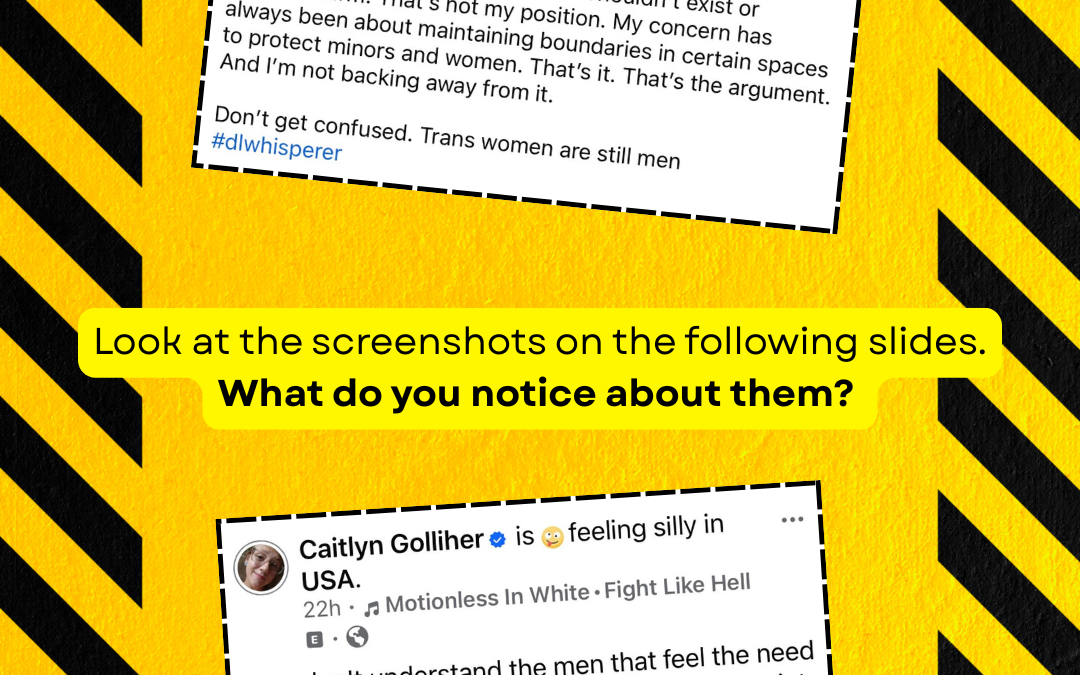
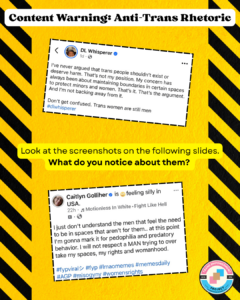
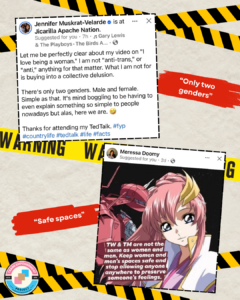
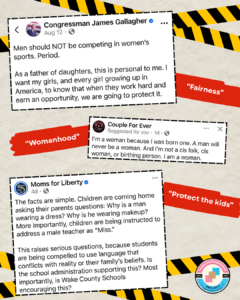
Look at the screenshots accompanying this article. Different people. Different posts. Seemingly different topics: bathrooms, schools, children, women’s rights, safety, privacy, fairness, protection.
What do they all have in common?
Maybe you caught it immediately. Maybe you didn’t. Either way, I need you to see it now, because once you do, an enormous amount of what passes for “debate” about transgender people starts looking very different.
You are being taught to fear trans people.
Story after story places transgender people next to the same emotional triggers: danger, children, women, invasion, deception, unfairness, loss, threat. A trans woman uses a bathroom, and somebody else’s privacy is supposedly at risk. A trans teacher goes to work, and children are being “exposed” to something. A trans athlete becomes evidence that women’s sports are under attack. A trans child becomes evidence that their parents are groomers.
The details change, but the underlying lesson remains the same: there is something you value, and trans people are threatening it.
That is why, this September, Sisterhood Not Cisterhood is joining Trans Empowerment Project’s #LouderWithLove campaign to teach people how to recognize these patterns, understand why they work, and interrupt them. Suicide prevention includes changing the environment people are being asked to survive in long before somebody reaches a crisis point.
Once you see the pattern, you start seeing it everywhere
There is a well-established phenomenon in psychology called the illusory truth effect. In plain language, repeated information tends to feel more credible and familiar than information we encounter only once. Research has found that repetition can increase belief in misinformation even when claims initially seem implausible or contradict things people already know.
Think about what that means in practice. You see a story about a trans woman in a bathroom. Then a story about a trans athlete. Then a story about a trans prisoner. Then a teacher. Then a child. Then a trans woman accused of a crime. Then another bathroom, another athlete, another school board meeting. Nobody has to put a giant graphic on your screen saying TRANS PEOPLE ARE DANGEROUS, because the association is already being built for you.
Protection language makes that association especially powerful: protect women, protect children, protect privacy, protect fairness. It gives us someone to care about while quietly telling us who we should fear.
One of the screenshots that pushed me toward this campaign involved a transgender elementary-school music teacher. Adults described a “biological male music teacher who presents as a woman,” scrutinized her clothing and makeup, and centered a child who reportedly felt uncomfortable around her. Strip away all of that framing and ask the question I want you to start asking every time you encounter one of these stories: What did the trans person actually do?
Children are extraordinarily capable of accepting new information about the world around them. A child who encounters a transgender teacher can simply be told that some people are transgender, people come in all kinds of bodies, and this woman is her music teacher. On the other hand, adults can also teach that child that she is looking at a “man in a dress,” that something deceptive or inappropriate is happening, and that children should have been protected from seeing her.
If adults teach a child that a particular kind of person is dangerous, they cannot then point to the child’s resulting fear as proof that they were right.
The same question matters when a trans person actually does something harmful. We should absolutely hold that individual accountable. But cisgender people commit crimes every day without every other cis person being required to establish why they should still be allowed near bathrooms, schools, or children. An entire community does not owe us collective innocence in exchange for being allowed to exist.
Cis women, they’re doing this in our name
For cis women in particular, I need us to notice how often we are told trans people are taking something from us: our bathrooms, sports, privacy, safety, language, even the word woman itself. That framing turns another woman’s inclusion into our loss.
I am one of the women these people keep claiming to protect, and they do not speak for me. My womanhood does not shrink because a trans woman’s womanhood is recognized. I don’t become less safe because she is safe. My privacy does not require her humiliation, and my rights do not become stronger when hers become weaker.
You don’t protect me by hurting her.
Sisterhood Not Cisterhood exists because I refuse to accept the premise that cis women and trans women belong in opposing camps. When someone says, “We don’t want trans women in our bathrooms,” cis women can answer: You don’t speak for me.
In fact, we need to be doing that.
We also need to understand where policing womanhood leads. Cis women have already been questioned, investigated, and confronted because they looked too masculine, had facial hair, muscular bodies, deep voices, or simply failed somebody else’s visual inspection of femininity. I have personally known cis women who were approached and intimidated in restrooms because a stranger assumed they were transgender.
Stop for a second and think about how profoundly messed up that is.
When did we decide strangers should be entitled to inspect another woman while she is trying to use the bathroom and determine whether her body sufficiently proves her right to pee? Once we empower people to decide which women look suspicious enough to investigate, every woman who falls outside somebody’s personal template of femininity becomes potentially inspectable.
You do not make women safer by empowering strangers to police their bodies.
We need to talk about where this can lead
Anti-trans rhetoric routinely describes transgender people as deceptive, dangerous, predatory, mentally ill, fraudulent, or inappropriate around children. Psychological research on dehumanization gives us good reason to take that seriously: dehumanization has consequences for empathy, moral judgment, social exclusion, aggression, and what treatment of another group people become willing to tolerate.
And yes, we need to talk about genocide. I know what happens when that word enters a conversation. People get uncomfortable. They worry that saying it is too extreme. They start reaching for reassurance that things could never really get that bad.
I am not going to give you that reassurance.
In February 2025, the Lemkin Institute for Genocide Prevention and Human Security warned that actions by the United States government were “in line with a genocidal process against the transgender community” that it said had been developing for more than a decade. Four months later, the Institute issued another Red Flag Alert warning that the process had “rapidly escalated.”
Genocide Watch identifies discrimination, dehumanization, polarization, and persecution among the processes societies should recognize and interrupt before mass violence reaches its worst possible endpoint. We should therefore be willing to sit with something terrifying: genocide is a possible outcome of unchecked anti-trans dehumanization, political scapegoating, discrimination, and state repression.
We do not know what the endpoint of the current trajectory will be. We do know that organizations whose work centers genocide prevention have looked at what is happening to trans people and sounded alarms using the language of genocidal process, escalation, and erasure.
That should scare us.
The answer to an early warning is not to keep sanding down the language until everybody feels comfortable again. History does not become history only after the bodies are counted. Every atrocity had a period when ordinary people could still tell themselves that surely it would never go that far.
Trans people are telling us they are frightened. Genocide-prevention institutions are sounding alarms. Governments are restricting healthcare, legal recognition, and participation in public life while the surrounding culture increasingly portrays trans people as threats to children, women, and society.
We do not need to know exactly how far this will go before deciding that our job is to stop it from going farther.
Less than three weeks ago, I experienced the hate first-hand
Less than three weeks ago, on my birthday, I made a Facebook post criticizing J.K. Rowling. I expected roughly the same audience most of my personal posts receive: a few friends, maybe a handful of reactions, and then Facebook would quietly bury it with everything else I post. After I made the post, I put my phone down and continued celebrating my birthday.
The next morning, I woke up to a pile of notifications. At first, I genuinely thought they were belated birthday messages or something of the sort.
They were very much not birthday messages.
My post had escaped my normal little corner of Facebook. It had been shared repeatedly, and hundreds of strangers were suddenly in my comments. Before I understood how large the pile-on had become, I laughed at a few of them. I even responded sarcastically to some. I have been online a long time, and a few random a-holes calling me something stupid is not particularly novel.
Then I saw how many comments there were, and I started reading. And reading. And reading.
The screenshots are still on my phone. I can still remember some of the comments almost word for word. These are not scars I have spent years polishing into a nice little story about resilience. I remember waking up expecting to continue my birthday celebrations through the weekend and feeling my mental health deteriorate in real time as I realized what hundreds of strangers were saying about me.
They attacked my body, appearance, intelligence, mental health, sexuality, and politics. They questioned whether I was a woman. They used slurs and normalized violence. Some echoed things previous abusers had said to me, and every comment became another tiny cut.
Somehow, they also started attacking me over trans people. I hadn’t mentioned trans people, bathrooms, sports, trans kids, pronouns, or gender-affirming care. I criticized J.K. Rowling, and the hate machine supplied everything else.
In less than 24 hours the number of comments had exceeded 700, and I wasn’t laughing anymore. I had expected to spend the weekend celebrating my birthday and instead ended up in a severe mental-health crisis. My husband eventually restricted the comments, deleted some of the worst ones, got me away from social media, and spent his time reminding me of all the things about myself that strangers had spent the day trying to make me forget.
I had support. I knew those people were wrong. I am a cis woman whose womanhood has never been questioned by society, and it still hurt like hell. I had spent years watching this machinery operate against trans people; Sisterhood Not Cisterhood exists because I already understood the harm. What those few days gave me was a visceral understanding of what hundreds of tiny cuts can do even when you know the knife is made of lies.
And I couldn’t stop thinking about trans people who experience this simply because they exist in public.
This is a suicide-prevention issue
The Trevor Project’s 2025 U.S. National Survey found that 86% of transgender and nonbinary young people surveyed had noticed harmful rhetoric about LGBTQ+ people during the previous year, and 40% had seriously considered suicide. Across LGBTQ+ young people, those who experienced in-person or online bullying reported attempting suicide at more than three times the rate of those who had not been bullied.
Trans identity does not inherently make somebody suicidal. People live inside environments, and rejection, discrimination, victimization, belonging, and support are part of those environments. Suicide prevention has to begin before somebody is already drowning by asking what kind of water we are making them swim through every day.
That brings me to those of us who call ourselves allies.
I need more from allies
I know plenty of people who support trans rights. They buy the shirt, share the Pride graphic, put the flag in their bio, and tell you they love their trans friends. I know far fewer cis people who regularly speak publicly about trans inclusion.
There is always a reason. They’re busy. They’re afraid of saying the wrong thing or being corrected. They don’t want to speak over trans people. They don’t want to confront their relatives. They definitely don’t want the Facebook mob turning toward them.
At some point, fear of doing allyship imperfectly becomes an excuse for not doing it at all.
Trans people are already expected to explain terminology, debunk misinformation, defend their healthcare, answer invasive questions, educate relatives, and confront people questioning their humanity. Those of us who call ourselves allies need to absorb more of that cost.
You might get corrected; then learn something and keep going. You might phrase something badly; fix it and keep going. Somebody might get angry that you spoke up. Keep showing up anyway.
Trans people themselves have told researchers that standing up for them matters. In Trevor Project’s research on supporting transgender and nonbinary young people, 85% identified “standing up for me” as something people in their lives could do to make them feel supported.
That is part of what #LouderWithLove is asking us to learn how to do. Sometimes showing up means correcting misinformation. Sometimes it means reporting abuse, documenting a threat, checking in privately, or offering to moderate somebody’s comments so they don’t have to read another hundred insults. Sometimes it means filling a comment section with enough humanity that the person being attacked can see the mob does not represent everybody.
And sometimes, especially for cis women, it means saying two very simple things:
You don’t speak for me. You don’t protect me by hurting her.
What I actually want
When I imagine what success looks like for Sisterhood Not Cisterhood and #LouderWithLove, I think about freedom. I want trans people to feel comfortable existing publicly without constantly calculating what it might cost them.
I want a trans woman to post the photo, wear the bikini, ask for makeup tips and proudly show how much she has learned. I want her to wear the dress with the frilly skirt, share the stupid meme, celebrate the haircut, talk about a terrible date, complain about work, be glamorous, be awkward, be loud, be shy, and be completely ordinary.
I want trans people to know that when somebody decides their ordinary existence is an invitation for cruelty, they will not automatically become responsible for educating, correcting and fighting every stranger who shows up. I want them to look at their comments and see allies already there. I want to see one hundred affirming comments for every hateful one.
I want #SNC to become a calling card. When somebody sees it beneath a supportive comment, I want them to know that somebody from Sisterhood Not Cisterhood is there. Our members should recognize each other and understand the assignment: support the person being targeted, add affirmation, report abuse where appropriate, offer help, and refuse to let hate occupy the entire space uncontested.
We are not building a mob to attack another mob, we are building a community of people who know how to make sure the person being hurt doesn’t have to stand there alone.
Trans people deserve to walk into a bathroom without wondering whether somebody will challenge them. They deserve to teach music without becoming a school-board controversy. They deserve to be teenagers whose biggest problem that day is an algebra test. They deserve the same boring, beautiful, messy freedom to exist that the rest of us expect for ourselves.
And those of us who really mean it when we call ourselves allies can help build that world.
Learn to see it. Then learn to interrupt it.
Over the next several weeks, Sisterhood Not Cisterhood and #LouderWithLove are going to dig deeper. We’ll teach the patterns that make anti-trans rhetoric effective, explain the psychology underneath them, and build practical tools for people who want to move from quietly supportive to actively useful.
For now, start paying attention. When you see a story involving a trans person, ask what actually happened before accepting somebody else’s framing. Notice who supposedly needs protection and who has been assigned the role of threat. Notice when one person’s actions become evidence against an entire community. Notice when somebody claims to speak for all women.
When somebody is targeted, show up. When you make a mistake, learn and come back. When a trans person tells you what support would help, listen. When hate gets repeated until it becomes familiar, help make love feel familiar too.
Make cis women standing beside trans women familiar. Make parents affirming trans kids familiar. Make trans teachers and trans neighbors familiar. Make trans joy familiar. Make seeing allies in the comments familiar. Make it so ordinary that trans people don’t have to keep wondering whether anybody is going to show up for them.
Want to keep going?
This article is only the beginning. Throughout September, we’ll be turning these ideas into practical tools you can actually use — including the “Learn to See It” downloadable guide, real-world examples and practice, and a live training on recognizing and interrupting anti-trans hate.
The best way to make sure you don’t miss any of it is to join our email list. We’ll send you the guide when it drops, the invitation to the live training, and the major resources from this campaign.
Want to talk about what you’re learning, bring us examples you’ve encountered, or practice alongside other people? Join the Sisterhood Not Cisterhood Facebook group. That’s where the conversation (and eventually our community bystander-support work) will live.
You don’t have to become an expert overnight. Just stay with us. Learn to see it. Learn to interrupt it. And when someone needs you, show up.
They are teaching people to fear the trans community. We are going to teach you to see how. And then we are going to teach you how to get #LouderWithLove.
Sources
Udry, J. & Barber, S. (2024). The illusory truth effect: A review of how repetition increases belief in misinformation. Current Opinion in Psychology.ScienceDirect
Haslam, N. & Loughnan, S. (2014). Dehumanization and Infrahumanization. Annual Review of Psychology.Annual Reviews
Genocide Watch. The Ten Stages of Genocide.Genocide Watch
Lemkin Institute for Genocide Prevention and Human Security. (2025). Red Flag Alert for the Anti-Trans Agenda of the Trump Administration in the United States.February 2025 alert; Red Flag Alert 2 for the Anti-Trans Agenda of the Trump Administration in the United States.June 2025 alert
The Trevor Project. (2026). 2025 U.S. National Survey on the Mental Health of LGBTQ+ Young People.National Survey; How to Best Support Transgender and Nonbinary Young People.Research Brief
By Jack Knoxville (he/they) · Trans Empowerment Project · March 31, 2026
Today is Trans Day of Visibility. And Trans Empowerment Project is spending it doing what we've always done — naming what's true, even when it's uncomfortable, and asking the people with power to use it differently.
Today, we're asking that of Mattel.
Here's what's happening
Mattel is one of the world's largest toy and game companies. They hold a top-100 rating from the Human Rights Campaign's Corporate Equality Index — a widely recognized benchmark for LGBTQ+ workplace inclusion. They've made public commitments to diversity, equity, and inclusion.
They also hold an active licensing agreement to produce Harry Potter merchandise. That means every sale generates royalties that flow back to J.K. Rowling — the IP owner, and the most prominent anti-trans activist in the world.
The tension
Mattel cannot simultaneously claim to champion LGBTQ+ people and financially sustain the platform of a person who has dedicated significant money and effort to stripping those same people of their rights.
We're not asking Mattel to have an opinion about fiction. We're asking them to look at what their licensing dollars are funding in the real world — and decide whose side they're actually on.
The receipts
This isn't a feeling. This isn't a culture war take. This is documented:
J.K. Rowling — what the public record shows
1
Donated £70,000 to For Women Scotland — an organization that actively campaigns against legal protections for trans people in the UK. (The Times, 2021)
2
Donated £70,000 to LGB Alliance — a UK organization that has opposed trans inclusion and campaigned against Mermaids, a support charity for trans youth. (The Guardian, 2021)
3
Co-founded Beira's Place — a rape crisis center that explicitly excludes trans women, mirroring legislative efforts to remove trans women from single-sex services. (Pink News, 2023)
4
Helped oppose Scotland's Gender Recognition Reform Bill — a bill that would have provided trans people a streamlined legal gender recognition process. The bill was effectively blocked. (BBC Scotland, 2023)
5
Her rhetoric has been directly echoed by US legislators pushing bathroom bans, healthcare restrictions for trans youth, and conversion therapy protections — bills that have caused real, documented harm to real families. (ACLU, GLAAD)
These are not opinions. These are financial and institutional decisions with real-world consequences for 2Spirit, Trans, Intersex, and Gender Expansive people everywhere.
"Every time someone buys a Mattel Harry Potter product, a portion of that revenue sustains the platform of a person who has made dismantling trans rights her public mission."
Why this matters to us — personally
Trans Empowerment Project was founded in 2016 to serve Disabled 2TIGE-BIPOC communities. In the years since, we've watched the political and cultural climate shift in ways that have directly, materially harmed the people we serve.
I've had to move because of what's happening. I know parents of trans kids who are terrified — kids being pulled off puberty blockers, denied access to bathrooms, turned away from healthcare. I know people who have lost jobs, homes, and communities. I know people who've lost the will to keep going.
This is not abstract. This is our lives.
And when a corporation with an HRC award on the shelf continues to financially sustain the person funding the legislation driving this harm — we say something about it.
For new visitors
Trans Empowerment Project is a federally recognized 501(c)(3) nonprofit. We've been supporting Disabled 2TIGE-BIPOC communities since 2016. We run programs including microgrants, community leadership development, and international advocacy. Learn more at transempowerment.org.
What we're asking Mattel to do
Our petition makes three specific asks:
1. End all current Harry Potter licensing agreements at the earliest contractual opportunity. We're not asking them to break a contract. We're asking them to not renew one.
2. Publicly commit to not entering new Harry Potter merchandise deals. A one-time exit isn't enough. We want a clear statement of intent.
3. Issue a transparent statement explaining how their licensing decisions align with their stated DEI values. Accountability requires transparency. We want Mattel to say — publicly — how they reconcile these two things.
What this is not
This is not a boycott of Harry Potter fans. It is not a call to burn books or erase a cultural franchise. It is a specific, targeted ask to a specific corporation about a specific business decision — one that directly contradicts their stated values.
How you can help — right now
Trans Empowerment Project has a direct reach of 53,000 people globally. If even a fraction of those people share this petition, we will be in front of millions within days. That kind of visibility brings press. Press brings pressure. Pressure creates change.
Share it everywhere. Instagram, TikTok, LinkedIn, BlueSky, Discord, text message, group chat. Especially share it with parents of trans kids, with teachers, with HR professionals, with anyone who works in corporate DEI.
Tag Mattel directly. @Mattel on Instagram, LinkedIn, and X/Twitter. Make sure they're seeing the conversation.
Tag @HRC. They certified Mattel. They should be asked to weigh in.
Trans Day of Visibility only comes once a year. But the harm Rowling's funding enables happens every day — in courtrooms, clinics, school boards, and family living rooms.
Today, we're visible. And we're using that visibility to do something with it.
In solidarity and spite,
J
Jack Knoxville (he/they)
Founder, Trans Empowerment Project transempowerment.org
Clothing is something a lot of people take for granted. You walk into a store, grab your size, maybe try something on, maybe not, and move on with your day.
But for 2TIGE folks, it’s rarely that simple.
For many of us, clothing is tied up in dysphoria, safety, access, and whether or not we’re going to be seen, questioned, or even harassed just for existing. Something as basic as trying on a shirt can feel loaded. Public. Risky.
And that’s exactly why clothing swaps matter as much as they do.
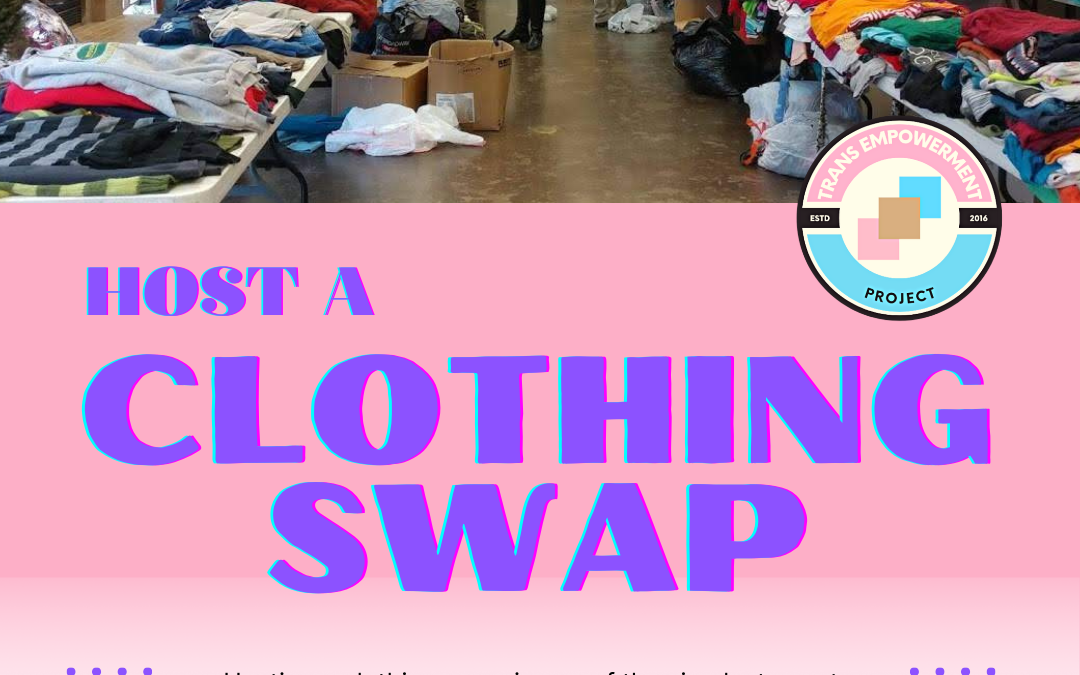
At Trans Empowerment Project, clothing swaps were one of the first things we ever organized. Not because they’re flashy or complicated, but because they meet a need that is both immediate and deeply personal.
There is something powerful about walking into a space where you don’t have to explain yourself. Where no one is watching you try to “figure it out.” Where you can pick something up, try it on, and have a quiet moment with yourself that says, oh… this feels right.
That moment? It stays with people.
It’s not just about leaving with clothes. It’s about leaving with a little more confidence, a little less isolation, and a reminder that you’re not alone in any of this.
We’ve seen it over and over again. People come in unsure, sometimes guarded, sometimes carrying a lot. And then something shifts. Conversations start. Laughter shows up. Someone finds something that fits in a way nothing has before, and you can literally see it in their posture.
That’s community. That’s what we’re actually building.
And right now, the need for those spaces is growing faster than we can meet it on our own.
We’re hearing from folks all over who are looking for access to affirming clothing, but just as importantly, they’re looking for spaces where they can exist without being questioned or policed. In a moment where 2TIGE lives are being debated, targeted, and pushed to the margins, creating spaces of care and visibility isn’t extra. It’s necessary.
That’s why we’re inviting people to host clothing swaps with us.
Not because we think everyone suddenly has to become an event organizer, but because we know that real change doesn’t happen from one place or one organization. It happens when people decide to create something where they are.
Hosting a swap doesn’t mean having everything perfectly figured out. It means opening up a space, however big or small, and making it clear that people are welcome there. It means being part of something that’s rooted in care, dignity, and connection.
And the impact of that reaches further than you might expect.
A single clothing swap can spark ongoing relationships. It can connect people who didn’t know each other before. It can give someone their first experience of feeling seen in a way that actually feels good. It can remind someone that they deserve to take up space exactly as they are.
That’s not small.
That’s the kind of thing that helps people keep going.
So if you’ve been wondering how to show up right now in a way that is tangible and real, this is one way to do it.
We’ve put together everything you need to get started, and we’ll be right there with you as you do.
Over the past few days, 12 people across 9 states have signed up to be part of this campaign. Not because they had to. Not because it was convenient. But because they believe in showing up — visibly — for the 2TIGE community.
And honestly? That matters more than ever right now.
We’re living in a time where 2Spirit, Trans, Intersex, and Gender Expansive people are being targeted in very real ways. Policies, rhetoric, and fear are all being used to push folks out of public life. And in the middle of all of that, a lot of people are wondering who actually has their back.
This campaign is one answer to that question.
Why This Matters
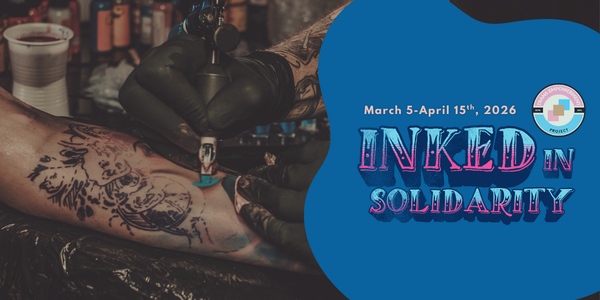
“Inked in Solidarity” isn’t just about tattoos. It’s about choosing to be seen in your support.
Because visibility does something that quiet support can’t.
When someone wears their solidarity on their body, it creates moments. Someone asks about it. A conversation starts. A message gets shared that might not have happened otherwise. And for someone in the 2TIGE community who sees that in passing — at a coffee shop, online, walking down the street — it can be a small but powerful reminder:
I’m not alone in this.
That’s the kind of impact we’re building here. Not just a fundraiser, but a ripple effect.
A Growing Movement
Right now, this campaign is already stretching across 9 states.
📍
Each person on that map is choosing to show up in a way that’s visible, lasting, and real. And we’re just at the beginning.
There’s something kind of beautiful about that. People who may never meet, connected by a shared decision to stand with the 2TIGE community in a way that can’t be ignored.
An Invitation
We’re inviting more people to step into this with us over the next few days.
Maybe you’ve been thinking about getting a tattoo for a while. Maybe you’ve been wondering how to show up in a way that actually feels meaningful. Maybe you’re just tired of watching what’s happening and want to do something that makes it clear where you stand.
If you’ve been online at all lately, you already know this: everything feels loud. And not in a fun way.
The hate is loud. The fear is loud. The doom scroll never shuts up.
And for 2TIGE (Two Spirit, Trans, Intersex, and Gender Expansive) folks, that noise isn’t just annoying — it seeps into our bodies, our nervous systems, our sense of safety. It makes rest feel impossible and joy feel irresponsible.
So we’re choosing something different.
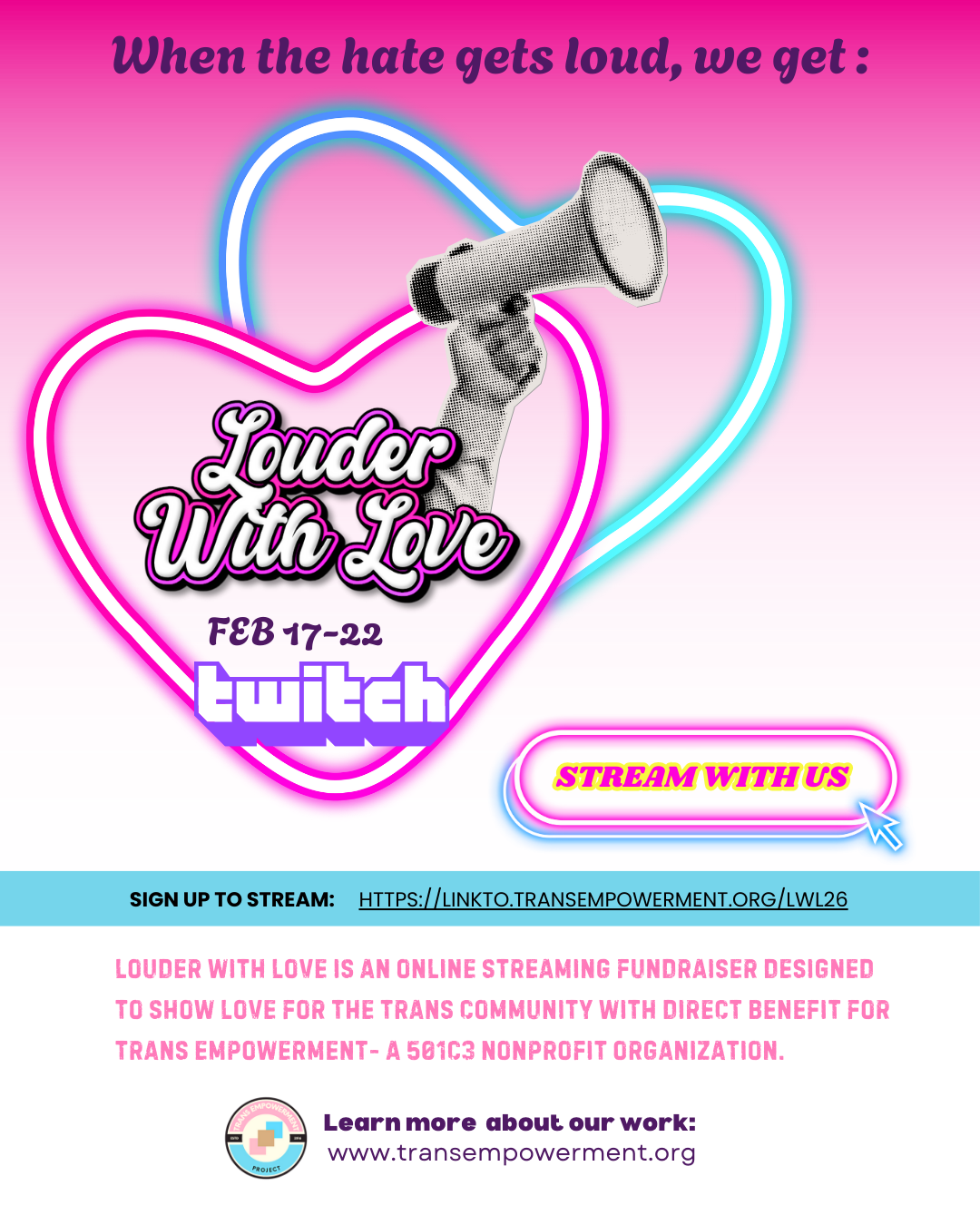
From Feb 17–22, we’re bringing back Louder With Love — a Twitch-based fundraising week rooted in joy, care, and showing up for each other without pretending things aren’t hard.
Not toxic positivity. Not “good vibes only.” Just… love, but loud enough to actually matter.
What Louder With Love Looks Like in Real Life
Louder With Love is simple on purpose.
Streamers show up on Twitch and do what they already do — play games, chat, create — and we invite their communities to help fund real support for Trans Empowerment Project and the 2TIGE folks we serve.
You can:
Run a dedicated fundraising stream
Add a donation goal to a regular stream
Raid, boost, or hype someone else’s stream
Or just help spread the word
We provide optional overlays, graphics, chat commands, and support so no one has to build this from scratch.
This isn’t about doing the most. It’s about doing something, together.
Let’s Be Honest for a Minute
We already have a few streamers signed up. They’re great. We love them.
And, we need to say this plainly, but that won’t be enough.
Our streaming program needs to bring in about $90,000 this year to keep Trans Empowerment Project running at the level our community needs. Louder With Love is the first of five fundraising events we’re rolling out to try to get there. If this one doesn’t land, everything else gets harder.
We can’t get there on small streams alone, no matter how much heart is in them. We need creators with bigger audiences to help us — even if it’s just for one stream.
How & Why We’re Inviting Streamers to Get SAFE
As part of Louder With Love, we’re inviting streamers to become SAFE-certified through our SAFE Stream training.
SAFE stands for Supportive, Accountable, Fair, and Empowering.
It’s not about being perfect. It’s about being honest. About saying, “If harm happens here, I won’t ignore it.”
SAFE-certified streamers get:
A badge or certificate they can display
Language to explain what SAFE means to their community
A way to signal care without making big promises they can’t keep
For 2TIGE folks who are constantly weighing whether a space is worth the risk, that signal matters.
Why We’re Asking You to Show Up
We don’t love having to say this part, but we’re not going to dance around it.
If we don’t hit our fundraising goals this year, our capacity shrinks even further; or we close our doors completely. And the people impacted first are the ones who already have the least room to absorb another loss.
We’re not asking anyone to save us. We are asking people with reach to show up with us. Because love, rooted in resources, is the only way we will keep our doors open this year.
Want to Join Us?
📅 Feb 17–22 🎮 On Twitch 💜 Join at the level that makes sense for you
We’ll bring the tools. You bring your voice. Let’s get #LouderWithLove together!
A Note for Creators with 10k+ Followers
This part’s for you.
We know your inbox is full. We know you get asked to support causes all the time. And we know saying yes to everything would burn you out fast.
So here’s the honest version.
One stream from a creator with your reach can do what dozens of smaller streams simply can’t. It can fund weeks of community support. It can keep training programs running. It can mean the difference between “we’ll try again later” and “we’re still here.”
We’re not asking for a long-term commitment. We’re not asking you to carry this alone. We’re asking for one moment of shared effort.
If you care about building safer internet spaces. If you care about Trans folks having places to land. If you’ve ever wondered how to use your platform without it feeling performative…
This is a way to do that.
Join us for Louder With Love, Feb 17–22. Even one stream helps more than you know.
The Supreme Court is reviewing state bans on transgender girls in school sports. The outcome could have major implications for LGBTQ students nationwide.
Idaho was the first state to totally ban Transgender student athletes from school sports in 2020, with West Virginia following in 2021. Since then, 25 other states have enacted sports bans restricting access to girls’ and women’s sports for trans students in schools and universities that receive public funds.
This past week on Jan. 13th, the U.S. Supreme Court heard over three hours of oral arguments in two cases challenging the Idaho and West Virginia laws: Little v. Hecox and West Virginia v. B.P.J. The cases ask whether state bans on transgender women and girls participating in school sports violate the Equal Protection Clause of the U.S. Constitution and Title IX, the federal law prohibiting discrimination “on the basis of sex” in education.
West Virginia v. B.P.J.
The West Virginia case centers on HB 3293, a law passed in 2021 that bans transgender girls from participating in girls’ school sports. The law was signed by Governor Jim Justice despite lawmakers being unable to identify any transgender athletes competing in the state at the time (CNN, Jan. 13, 2026).
The lawsuit was filed on behalf of Becky Pepper-Jackson, a 15-year-old trans girl who wants to continue participating in cross-country and track and field. Supporters of the challenge argue that the law singles out transgender students for exclusion and is opposed by many women athletes, sports organizations, and medical professionals (SCOTUSblog, Jan. 13, 2026).
Little v. Hecox
Little v. Hecox challenges Idaho’s 2020 law, HB 500, banning transgender women from school sports and allowing sex verification testing. The case was brought by Lindsay Hecox, a Trans woman who sought to try out for women’s athletic teams at Boise State University (CNN, Jan. 13, 2026).
The plaintiffs are represented by the American Civil Liberties Union, the ACLU of Idaho, Legal Voice, and Cooley LLP, who argue that the law discriminates based on sex and gender identity without evidence of harm or unfair advantage.
Opposition to the Bans
In their fight against these bans, Becky Pepper-Jackson and Lindsay Hecox have drawn support from prominent figures in women’s sports like Billie Jean King, Megan Rapinoe, Sue Bird, Brianna Turner, and Dawn Staley. Major organizations like the Women’s Sports Foundation and the National Women’s Basketball Players Association have also opposed the bans, along with numerous medical professionals. These supporters argue that the laws unfairly single out transgender students for exclusion.
Ominous Signals from the Court
Despite lower courts consistently blocking the bans as violating the rights of Trans students, a majority of the Supreme Court justices seemed to agree that the Idaho and West Virginia laws can remain in effect. According to Amy Howe of CNN, The Supreme Court’s three Democratic members “appeared to recognize that the challengers faced an uphill battle. They seemed to devote much of their efforts to mitigating their losses – either by getting one case thrown out or by limiting the court’s decision to a narrow one.”
The outcome of these cases could shape how Title IX and constitutional protections apply to transgender students nationwide, with particular consequences for Trans youth seeking equal access to school activities (SCOTUSblog, Jan. 13, 2026).
The justices are expected to make their decision by June 2026.
10 Things You Can Do To Show Up For Your Trans Loved Ones
The holidays are rolling in again — twinkly lights, sweater weather, and that one cousin who insists on “playing devil’s advocate” even though nobody asked. For many Two-Spirit, Trans, Intersex, and Gender-Expansive (2TIGE) folks, this season can feel like a mixed bag: joy, anxiety, celebration, and the ever-present question of whether family gatherings will feel welcoming or…something less than that.
If someone you love is 2TIGE, the way you show up can make the difference between a holiday that feels safe and affirming, or one that they spend silently bracing themselves. The good news? Being a supportive, thoughtful ally isn’t complicated. It just takes intention, humility, and a willingness to prioritize their comfort over anyone else’s convenience.
Here are ten ways to show up with real love, respect, and solidarity this holiday season — and beyond.
1. Use Their Name and Pronouns (Yes, Every Time!)
Affirming someone’s name and pronouns is the foundation of showing respect. If your loved one has shared theirs with you, use them consistently, even when you’re reminiscing about childhood stories or talking to relatives who “don’t get it yet.” If you’re unsure of their pronouns or how they introduce themselves these days, ask ahead of time instead of guessing.
Singular “they” is not new, confusing, or grammatically rebellious. You’ve used it your whole life. If you can say “Someone left their casserole on the counter,” you’re already doing it. It’s not about perfection; it’s about practice and commitment.
2. Check In Ahead of Time and Do Your Own Learning
Before the gathering, reach out and ask how they’re feeling about the holiday and what would help them feel supported. Maybe they want you to correct people gently on their pronouns. Maybe they want backup around certain relatives. Maybe they just want a neutral, judgment-free space to exist.
Whatever they share, honor it, and then take responsibility for your own education. If they seem open to talking, great. If not, don’t treat them like a walking encyclopedia of transness. The emotional labor of explaining themselves shouldn’t fall on them just because you’re curious. You can learn plenty from vetted resources (and you’ll find some below).
3. Don’t Ask Questions You Wouldn’t Ask a Cis Person
This one’s simple: if you wouldn’t ask a cisgender friend or family member a particular question, you shouldn’t ask your trans loved one either. Curiosity is normal, but bodies, medical decisions, and personal details are private. Questions like “Have you had surgery?” “What’s in your pants?” or “Which bathroom do you use?” are inappropriate, invasive, and irrelevant to who they are as a human being.
Respect their boundaries the same way you’d want yours respected.
4. Rethink Gendered Traditions
Families often have deeply ingrained gendered roles during the holidays: the women cook, the men watch football, or gifts are exchanged “by the boys” and “by the girls.” These traditions can feel alienating or painful for trans and non-binary relatives.
If your loved one is a trans man or trans woman, include them wholeheartedly in traditions that match their identity, versus ones assigned to them at birth. If they’re non-binary, talk with them about what feels comfortable or brainstorm new traditions together ahead of time. Safety and inclusion matter more than nostalgia.
5. Tell Old Stories the Right Way and Be Careful with Photos
Stories of childhood mischief and awkward middle-school moments can be sweet, but retelling them requires a little extra care. Use your loved one’s current name and pronouns when sharing memories. There’s no need to call in memories with language like “when you were a boy/girl”. These story still land without that kind of framing. Instead try something like “When you were younger”.
Photos are trickier. Some 2TIGE people enjoy looking back at old pictures; others find them dysphoric or painful. Always ask privately before pulling out old albums, passing around pre-transition pictures, or posting anything online. Even well-intentioned nostalgia can cross a boundary without meaning to.
6. Remember: Their Story Is Theirs to Share
Just because your loved one came out to you does not mean they’ve come out to everyone else in their life. They may not be out at work, school, church, or within certain parts of the family. Outing someone (even accidentally) can put them at risk socially, professionally, and in today’s climate, sometimes physically. Ie- just because you’re cool, doesn’t mean everyone else at the table is or will be.
Let people control their own narratives. If someone asks a question that you’re unsure how to navigate, try redirecting instead of revealing information that isn’t yours to disclose.
(Example: Your Trans loved one leaves the room, and suddenly Aunt Susan wants to know about their surgery status, you don’t need to give her a play by play, instead allow your Trans loved one to decide if/when they want to share that story and redirect the conversation to a favorite memory or anything else. If she or anyone else persists, it’s okay to be direct and let them know that that is not your story to share.)
7. Give Gifts That Celebrate Who They Are, Not Who You Assume They Should Be
Buying gifts for a newly out 2TIGE loved one doesn’t have to feel intimidating. The best strategy is the simplest: ask them what they want. Maybe they’re building a new wardrobe, exploring skincare or makeup for the first time, or trying out new hobbies or styles. They may also appreciate something fun, silly, comforting, or nostalgic (especially things they were denied growing up due to gendered expectations).
The goal isn’t to “get it perfect.” It’s to choose something that creates joy and says: I see you.
8. Stand Up to the Problematic Relative(s) – You Already Know Exactly Who We’re Talking About
Almost every holiday table has that one person who refuses to adjust, makes snide comments, misgenders people “on principle,” or wants to debate human rights like it’s fantasy football. Your loved one shouldn’t have to defend themselves alone.
Being an ally means stepping in; Calmly, confidently, and consistently. You don’t need to be confrontational to be firm. A simple “We’re using their correct name,” or “Hey, that’s not respectful,” is more powerful than you think. When allies speak up, 2TIGE people don’t always have to carry that burden themselves.
Allyship is a verb. Practicing it shows that you mean what you say.
9. Prioritize Their Comfort Over Your Discomfort
It’s okay if using new pronouns feels unfamiliar at first or if you’re nervous about correcting others. What’s not okay is putting the weight of your feelings onto your 2TIGE loved one. Their comfort, safety, and humanity are not optional because you feel awkward or uncertain.
If you care about them, truly care, then yes, stretch! Try new things. You’re going to get braver and things will get easier. That’s part of loving someone who needs you in their corner.
Their safety is more important than anyone else’s discomfort. Full stop.
10. When You Mess Up (And You Will), Fix It and Move Forward
No one expects perfection. What matters is how you respond. If you use the wrong pronoun or name, correct yourself quickly, apologize once, and move on. Don’t make a scene, spiral, or demand reassurance. Your loved one shouldn’t have to comfort you for a mistake you made.
The most respectful and authentic apology is changed behavior — not theatrics, not self-flagellation, and not turning your error into an entire holiday subplot.
After the Holidays: Keep Showing Up
Support doesn’t end when the decorations get boxed up. Keep checking in. Keep learning. Keep standing up when you need to. And most importantly, keep celebrating your loved one outside of crisis moments or visibility days. Trans people deserve ordinary joy, everyday safety, and people who stick around long after the holidays fade out.
In a world where understanding and empathy are more crucial than ever, our recent Ally Academy training called Privilege and Power -Understanding Your Role in Oppression offered a wealth of insights. Whether you’re a seasoned advocate or just beginning your journey, the highlights below will inspire and empower you to make a difference. Dive into the top five takeaways to transform your approach to allyship and community support.
1. Privilege: The Superpower You Didn’t Know You Had!
Privilege isn’t just a buzzword—it’s a tool for change. Recognizing your privilege is the first step in using it to uplift others. As Heather Knoxville, COO of Trans Empowerment Project, emphasized, “Privilege exists. There’s nothing wrong with having it; it’s what you do with it that matters.” By understanding and leveraging your privilege, you can amplify marginalized voices and drive systemic change.
2. Intersectionality: The Secret Sauce to Effective Allyship
Understanding intersectionality is key to being a true ally. It’s about recognizing how various identities—like race, gender, and ability—intersect to shape unique experiences. As the training highlighted, “A white 2TIGE man and a Black 2TIGE woman both experience discrimination, but only the latter also faces anti-Black racism.” Embrace this complexity to better understand and support those around you.
3. Power Mapping: Your Blueprint for Change
Feeling overwhelmed by systemic oppression? Power mapping is your answer. This strategic tool helps identify decision-makers, influencers, and allies to effectively challenge harmful policies. Whether it’s a school board implementing an anti-2TIGE sports ban or a workplace overlooking 2TIGE employees, power mapping reveals where change is possible and how you can contribute.
4. Redistributing Resources: Small Actions, Big Impact
Supporting the 2TIGE community doesn’t always require grand gestures. Simple acts like donating to 2TIGE-led funds, hiring 2TIGE individuals, or recommending them for opportunities can make a world of difference. As Jack Knoxville, founder of the Trans Empowerment Project, noted, “Even two or three dollars can make a huge impact.” Your contributions, no matter the size, help create a more equitable world!
5. Speak Up: Your Voice is a Catalyst for Change
Silence is complicity. Whether on social media or in personal conversations, use your voice to challenge discrimination and support the 2TIGE community. Whether you have influence over 5 or 5 million, your own social media accounts are wonderful platforms and catalysts you can use today to plant seeds of change.
Your words have power—use them to foster understanding and drive progress!
By embracing these insights, you’re not just becoming a better ally; you’re joining a movement towards a more inclusive and equitable future. Let’s continue to celebrate diversity, promote healing, and uplift every voice in our community. Together, we can make a difference.
As we celebrate Transgender Day of Visibility in 2025, I want to take a moment to highlight a painful reality that often goes unnoticed—the horrific situation of transgender individuals who flee their home countries seeking safety, only to find themselves trapped in yet another cycle of persecution and neglect.
Many transgender refugees escape their countries due to extreme violence, discrimination, and even threats to their lives. They flee with the hope of finding protection in nations that have signed international agreements to safeguard asylum seekers. However, upon arrival, they are met with further marginalization—not just from host governments but also from human rights organizations like UNHCR, which are meant to protect them.
In refugee camps, where they are placed as a form of “protection,” transgender individuals often face severe discrimination, harassment, and even torture. Transphobia runs deep, and instead of being safe, they are exposed to the same dangers they tried to escape. Many are left with no choice but to flee once again—this time from the very camps meant to shield them.
With limited options, some transgender refugees seek safety in other countries, even those that are unstable or engulfed in war. But no matter where they go, the cycle of suffering continues—rejected, unprotected, and forced to endure the same violence they had hoped to leave behind.
Visibility must go beyond celebration; it must be a call to action. The international community must recognize the urgent need for real protection for transgender refugees—protection that does not merely place them in unsafe environments but ensures their dignity, security, and right to live without fear.
To all transgender refugees struggling to survive, I see you. We see you. Your fight is not invisible. And we will continue to speak out until the world listens.
Written by Cyara Kiara, Transgender womxn and Human Rights Defender, Member TEP Africa
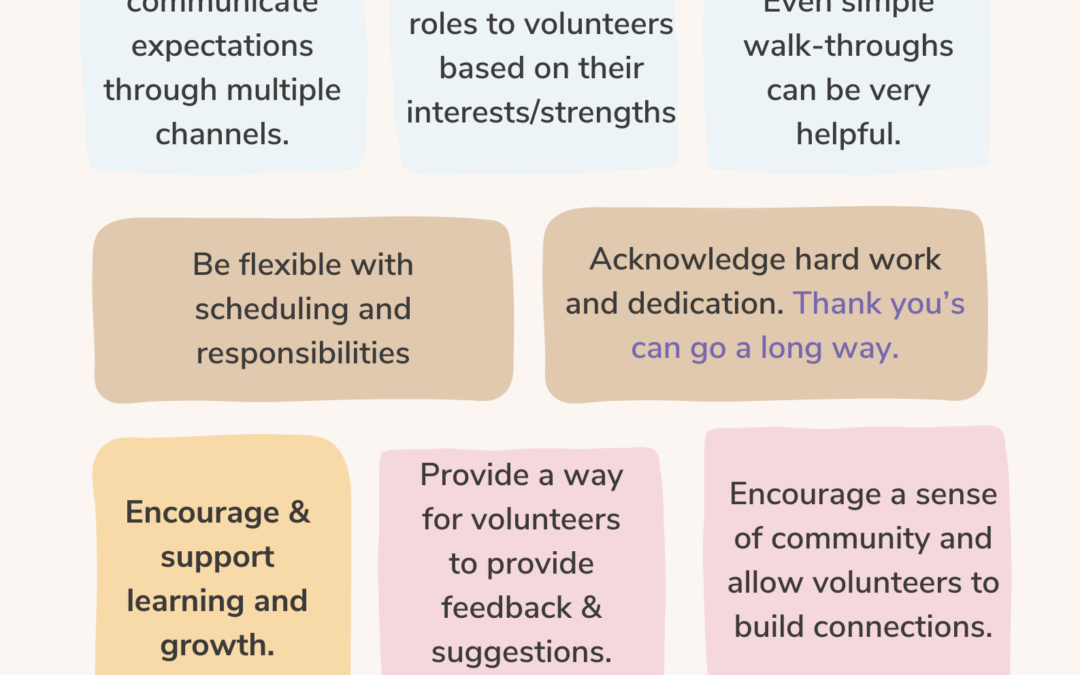
Managing volunteers can be a fun and rewarding experience. However, it can also get really messy really quickly. Therefore, it’s important to set clear and well defined expectations early on. Additionally, not all volunteers were created equally. Some folks may need a little more hand holding than others. Remember to practice anti-racism in your relationships when managing all staff and volunteers. We’re each coming to the table with different experiences, skillsets, ambitions, and abilities.
Below are 10 tips for managing volunteers more effectively:
1. Clear Communication
Ensure all instructions and expectations are clearly communicated to your volunteers. Using multiple channels like email, text, and face-to-face briefings ensures that everyone is on the same page. 2. Well-Defined Roles
Assign specific roles to volunteers based on their strengths and interests. Clearly defined roles with clearly defined tasks helps prevent confusion and ensures a smooth operation. 3. Training and Orientation
Provide necessary training and orientation sessions for volunteers. This doesn’t always have to be formal; a simple walkthrough or demonstration might be enough. Start with the absolute basics and don’t assume anyone’s experience or comfort level with the tools and skills they need to know. 4. Flexibility
Be flexible with scheduling and responsibilities. Volunteers are offering their time freely, so accommodating their schedules when possible can increase satisfaction and retention. 5. Recognition and Appreciation
Acknowledge their hard work and dedication. Recognition can be as simple as a public thank you, certificates, or small tokens of appreciation. 6. Feedback Mechanism
Have a system in place for volunteers to provide feedback about the events and actions you are leading. This can help identify areas for improvement and help ensure your volunteers feel valued. 7. Build a Community
Encourage camaraderie among volunteers. Fostering a sense of community, and creating spaces for volunteers to connect socially, can make the experience more enjoyable and increase the likelihood of them volunteering again. 8. Supply Necessary Resources
Ensure volunteers have all the tools and resources they need to perform their tasks efficiently. Lack of resources can lead to frustration and hinder their ability to help. 9. Emergency Preparedness
Prepare your volunteers for any emergencies. Brief them on emergency procedures and ensure they know who to contact in different scenarios. 10. Stay Positive and Supportive
Lead by example with a positive attitude. Support your volunteers by being available and approachable. Your positivity will reflect on their performance and overall experience.


![[Community Contributor] In Solidarity With Trans Refugees in East Africa](https://transempowerment.org/wp-content/uploads/2025/03/IMG_7064-1-756x675.jpeg)